


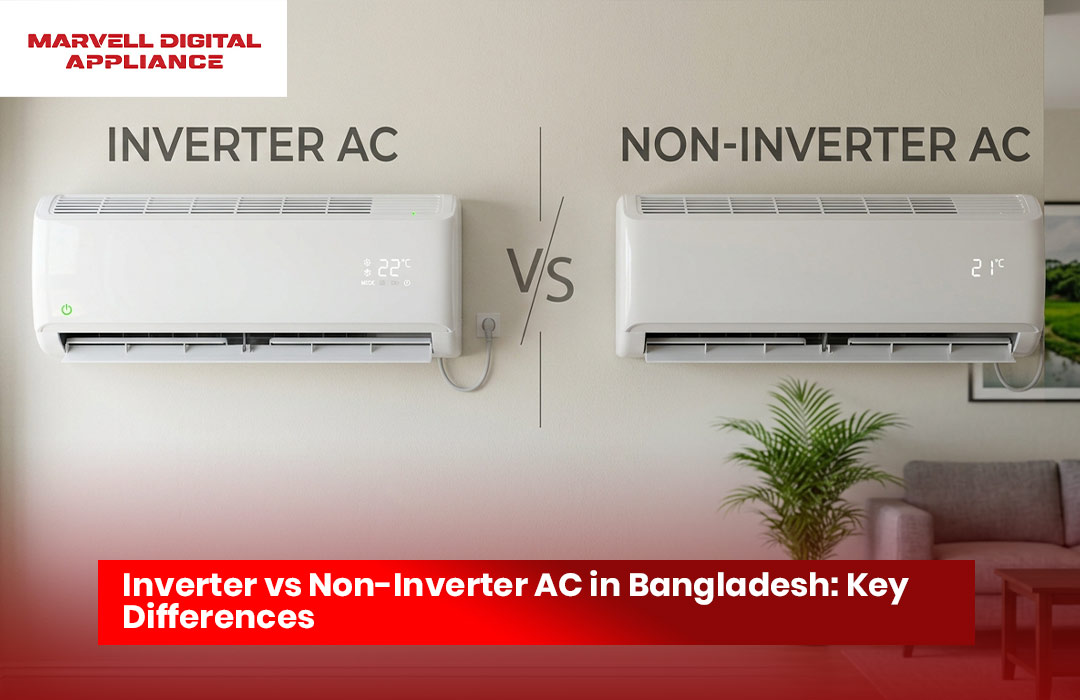
Choosing the right air conditioner can make a big difference to your comfort and monthly electricity bill. In Bangladesh, where air conditioners are used regularly during hot and humid months, many buyers are confused about inverter vs non-inverter AC.
Although both types of air conditioners can provide effective cooling, they work differently. The main difference is how the compressor operates. An inverter AC uses a variable-speed compressor, while a non-inverter AC uses a fixed-speed compressor that switches on and off according to the room temperature.
If you are planning to buy an AC for your home or office, understanding the difference between inverter and non-inverter AC can help you choose the right model based on your budget, usage and electricity consumption.
What Is an Inverter AC?
An inverter AC uses advanced compressor technology that allows the compressor speed to increase or decrease depending on the cooling requirement.
When you first turn on the AC, the compressor can operate at a higher speed to cool the room quickly. Once the desired temperature is reached, the compressor slows down instead of completely switching off. This allows the AC to maintain a more consistent temperature while using only the amount of power required.
This variable-speed operation is one of the main reasons inverter ACs are generally more energy efficient, particularly when they are used for several hours at a time.
Benefits of Inverter AC
- Lower electricity consumption during extended use
- More consistent room temperature
- Quieter operation in many models
- Better comfort for long-duration use
- Reduced compressor start-stop cycling
- Suitable for bedrooms, living rooms and offices
- Potentially lower long-term operating costs
What Is a Non-Inverter AC?
A non-inverter AC, also known as a fixed-speed AC, uses a compressor that generally operates at a fixed capacity.
When the room temperature rises above the selected temperature, the compressor switches on and operates at full capacity. Once the desired temperature is reached, the compressor switches off. This on-and-off cycle repeats to maintain the room temperature.
Non-inverter ACs can still provide effective cooling and are often less expensive to purchase initially. They can be a practical choice for people who use an AC for shorter periods or have a limited upfront budget.
Benefits of Non-Inverter AC
- Lower initial purchase price
- Simple operating technology
- Effective cooling
- Suitable for occasional use
- Can be a practical choice for rooms that are not used regularly
Inverter vs Non-Inverter AC: Key Differences
The following table provides a quick comparison between inverter and non-inverter air conditioners.
|
Feature |
Inverter AC |
Non-Inverter AC |
|
Compressor |
Variable-speed |
Fixed-speed |
|
Compressor operation |
Adjusts speed according to cooling demand |
Turns on and off |
|
Electricity consumption |
Generally lower during extended use |
Generally higher during frequent operation |
|
Temperature control |
More consistent |
More temperature fluctuation |
|
Noise |
Usually quieter during low-speed operation |
Can be louder during compressor start-up |
|
Initial price |
Usually higher |
Usually lower |
|
Long-term running cost |
Generally lower |
Generally higher |
|
Best for |
Regular and long-duration use |
Occasional or short-duration use |
|
Technology |
More advanced |
Traditional |
|
Comfort |
More stable cooling |
Cooling cycles can cause fluctuations |
The actual electricity savings depend on several factors, including room size, AC capacity, temperature setting, insulation, outdoor temperature, usage duration and the efficiency rating of the specific model. Therefore, claims of a fixed percentage of savings should not be applied to every AC.
Inverter AC vs Non-Inverter AC: Electricity Consumption
One of the biggest reasons people compare inverter vs non-inverter AC in Bangladesh is electricity consumption.
A non-inverter AC repeatedly starts and stops its compressor. When the compressor starts, it operates at its fixed capacity until the desired temperature is reached. An inverter AC, on the other hand, can reduce compressor speed once the room becomes cool.
For this reason, an inverter AC can be more efficient when it runs for several hours continuously. The longer and more consistently the AC is used, the more important operating efficiency becomes.
However, an inverter AC does not automatically guarantee a specific percentage of electricity savings. Actual consumption depends on the model and the conditions in which it is used.
Which AC Cools Faster?
Both inverter and non-inverter ACs can cool a room effectively when the AC has the correct capacity.
An inverter AC can initially operate at higher capacity to bring down the room temperature and then reduce compressor speed to maintain the desired temperature. A non-inverter AC typically operates at its fixed compressor capacity until the thermostat reaches the set temperature.
The quality of cooling also depends on the AC’s BTU capacity, room size, insulation, number of occupants, sunlight exposure and outdoor temperature.
Therefore, choosing the correct AC capacity is just as important as choosing between inverter and non-inverter technology.
Temperature Control and Comfort
Another important difference between inverter AC and non-inverter AC is temperature stability.
An inverter AC continuously adjusts compressor speed according to cooling demand. This can help maintain a more stable indoor temperature.
A non-inverter AC cycles the compressor on and off. As a result, you may notice more noticeable temperature changes as the compressor starts and stops.
For bedrooms and living spaces where the AC operates for many hours, consistent temperature control can make an inverter model more comfortable.
Noise Level
Noise can also influence your AC buying decision.
Because an inverter AC can reduce compressor speed after reaching the desired temperature, it may operate more quietly during periods of lower cooling demand. Non-inverter ACs operate their compressors at a fixed speed and repeatedly start and stop, which can make the operation more noticeable.
However, noise levels vary from one model to another, so it is important to check the manufacturer’s specifications before purchasing.
Initial Price vs Long-Term Cost
One of the biggest advantages of a non-inverter AC is its lower initial purchase price.
Inverter ACs generally cost more because they use more sophisticated compressor control and electronic components. However, the higher initial price may be offset over time by lower electricity consumption, particularly for households that use their AC for several hours every day.
For example, if you use an AC mainly at night for several hours, an inverter model may make more financial sense over the long term. If an AC is used only occasionally, the lower upfront price of a non-inverter model may be more attractive.
Which Is Better: Inverter or Non-Inverter AC?
There is no single answer for everyone. The better option depends on how you plan to use your air conditioner.
Choose an Inverter AC If:
- You use your AC for several hours every day.
- You want to reduce long-term electricity costs.
- You prefer stable room temperatures.
- You want quieter operation during low cooling demand.
- You are comfortable paying more initially for better efficiency.
- You are buying an AC for a bedroom, living room or frequently used office.
Choose a Non-Inverter AC If:
- Your initial budget is limited.
- You use the AC only occasionally.
- The room does not require continuous cooling.
- You want a lower upfront purchase price.
- You are buying an AC for a guest room or occasionally used space.
What Should You Consider Before Buying an AC in Bangladesh?
Choosing between inverter and non-inverter technology is only one part of buying an air conditioner. Before purchasing, consider the following factors.
1. Room Size
Choose an AC capacity that matches your room. An undersized AC may struggle to cool the room, while an oversized unit may not always provide the best efficiency or humidity control.
2. Daily Usage
Think about how many hours you normally run the AC. If you use it for extended periods every day, energy efficiency becomes increasingly important.
3. Energy Efficiency
Check the manufacturer’s energy-efficiency information rather than relying only on the word “inverter.” Two inverter ACs can have different efficiency levels.
4. Cooling Capacity
Consider the AC’s BTU or tonnage and whether it is appropriate for your room size and conditions.
5. Warranty and After-Sales Service
Choose a brand and seller that provide reliable warranty coverage and after-sales service. This is particularly important for inverter models because they contain electronic control components.
6. Installation Quality
Even a high-quality AC may not perform efficiently if it is incorrectly installed. Professional installation, appropriate refrigerant piping and proper outdoor-unit placement can affect performance.
7. Maintenance
Regular cleaning of filters and proper servicing help maintain cooling performance and efficiency. A dirty filter can restrict airflow and make the AC work harder.
Inverter vs Non-Inverter AC: Which One Is Best for Bangladesh?
For many households in Bangladesh, an inverter AC can be a strong choice if the air conditioner is used regularly for several hours a day. Its variable-speed compressor can adjust cooling output according to demand, helping provide stable comfort and potentially reducing electricity consumption.
A non-inverter AC can still be a good option for buyers who prioritize a lower initial cost or only need air conditioning occasionally.
Ultimately, the best choice depends on your room size, daily usage, electricity budget, upfront budget and cooling requirements.
Final Verdict
When comparing inverter vs non-inverter AC in Bangladesh, the biggest difference is compressor operation.
An inverter AC adjusts compressor speed according to cooling demand, which can provide more consistent cooling and better efficiency during extended use. A non-inverter AC uses a fixed-speed compressor that switches on and off, making it simpler and generally more affordable initially.
If you use your AC regularly and want better long-term efficiency, an inverter AC is often worth considering. If you only use an AC occasionally and want to minimize the initial purchase cost, a non-inverter AC may be suitable.
Before making your final decision, compare the AC’s cooling capacity, energy-efficiency specifications, warranty, features and price—not just whether it is an inverter model.
Frequently Asked Questions
Is an inverter AC better than a non-inverter AC?
For regular, long-duration use, an inverter AC is generally the better choice because it can adjust compressor speed according to cooling demand. However, a non-inverter AC can be suitable for occasional use and lower upfront budgets.
Does an inverter AC save electricity?
An inverter AC can use less electricity than a comparable fixed-speed AC, especially during extended operation, because the compressor can slow down instead of repeatedly switching fully on and off. Actual savings vary depending on the model and usage conditions.
Is an inverter AC worth buying in Bangladesh?
If you use your AC regularly for several hours a day, an inverter model can be a worthwhile long-term investment because of its efficiency and stable temperature control.
Which AC is better for a bedroom?
An inverter AC is often a good choice for bedrooms because it can maintain a more consistent temperature and may operate more quietly when cooling demand is low.
Is a non-inverter AC good for occasional use?
Yes. If an AC is used only occasionally or for short periods, a non-inverter model can be a practical option because its initial purchase cost is generally lower.
Does inverter AC cool faster than non-inverter AC?
Cooling speed depends on the AC’s capacity, model and room conditions. An inverter AC can increase compressor output during initial cooling and then reduce it as the room reaches the target temperature.
What is the main difference between inverter and non-inverter AC?
The main difference is compressor operation. An inverter AC uses a variable-speed compressor, while a non-inverter AC uses a fixed-speed compressor that cycles on and off.